

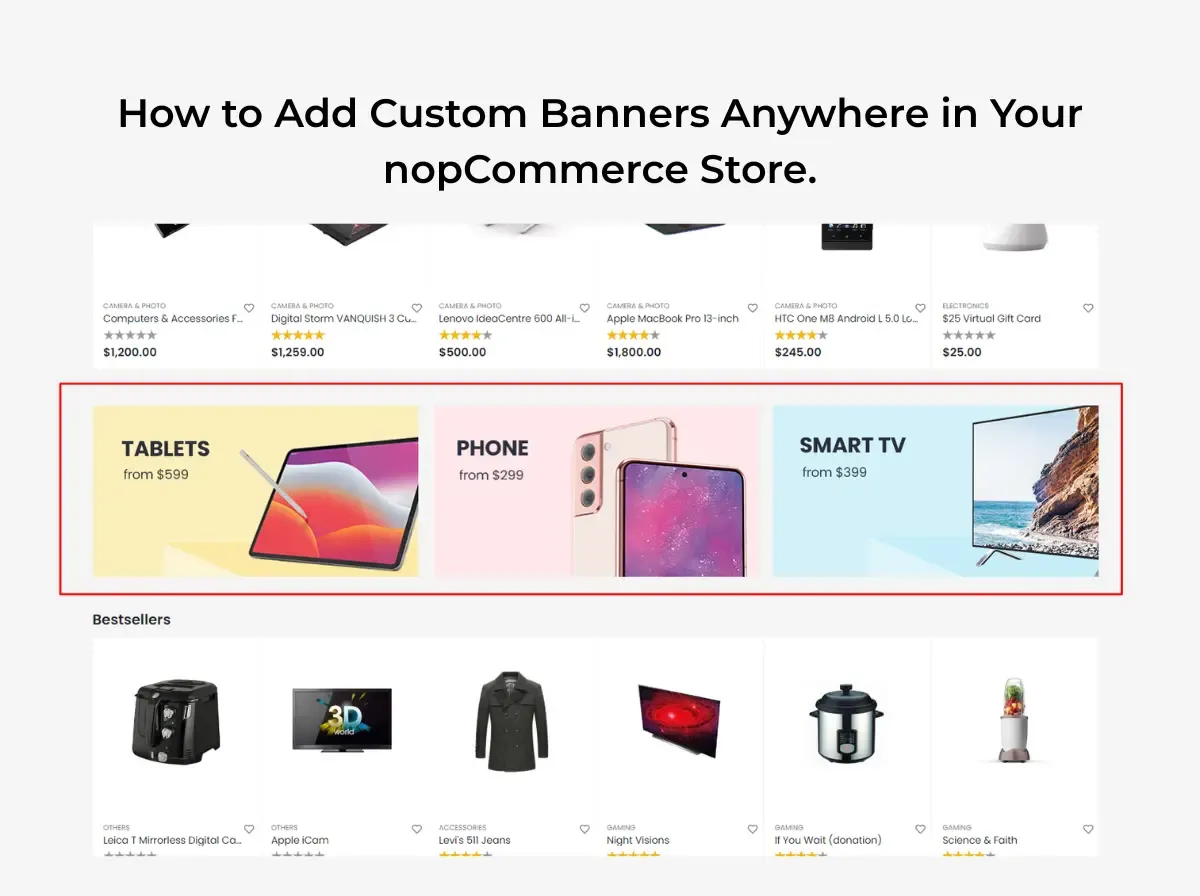
How to Add Custom Banners Anywhere in Your nopCommerce Store
Banners are one of the simplest tools a store owner has for communicating with shoppers. A well-placed banner can announce a seasonal offer, introduce a new product line, promote a specific category, or simply remind visitors that orders over a certain amount ship free. Retailers use banners for limited-time offers, brand campaigns, and trust messaging things like return policies or delivery timelines because a banner sits in the shopper's field of view without requiring them to read a full page of copy.
The trouble most nopCommerce store owners run into isn't whether to use banners. It's how to place them. In a typical nopCommerce setup, adding a banner to a new spot on the site, a footer zone, a category page, a specific widget zone, often means asking a developer to touch the theme templates. That's fine for a one-time change. It becomes a bottleneck when a marketing team wants to run five campaigns a month across different sections of the store.
This is where a nopCommerce banner plugin becomes relevant. Instead of hardcoding banner markup into .cshtml files every time a campaign changes, a banner plugin gives store administrators a way to manage banner content from the admin panel and place it in supported areas of the store. Shivaay Soft - own contribution to this space is the nopCommerce Anywhere Banner Plugin, a plugin included across several of its nopCommerce theme packages. This article walks through where banners are commonly used in a nopCommerce store, how to approach adding them, and where a banner plugin fits into that workflow. It won't claim that banners automatically drive more sales that depend entirely on relevance, design, and where a banner sends the visitor. What it will do is lay out a practical, technically grounded approach to banner placement in nopCommerce.

Why Custom Banners Matter for a nopCommerce Store
Banners serve more than one purpose, and it helps to be specific about which job a given banner is doing before deciding where to put it.
Promotions a discount, bundle offer, or flash sale.
Merchandising drawing attention to a specific product line or collection without redesigning the homepage.
Product discovery surfacing items a shopper might not find through normal browsing or search.
Category navigation helps shoppers understand what a category contains or how it's organized.
Seasonal campaigns aligning the storefront with a holiday, event, or time-limited push.
Brand communication reinforcing tone, values, or a brand story.
Customer education explaining shipping policies, return windows, or how a loyalty program works.
It's worth distinguishing between banner types, because they behave differently:
Decorative banners exist mainly to make a page feel finished. They carry little or no call to action.
Promotional banners exist to drive a specific action tied to a specific offer.
Informational banners communicate policy or service details, shipping thresholds, return windows, security badges.
Navigation banners help shoppers move toward a category, collection, or curated set of products.
Campaign banners are time-bound and tied to a specific event, launch, or seasonal push.
The common thread across all five is that banner placement should support the shopping journey, not interrupt it. A banner that competes with the product grid for attention, or sends a shopper somewhere unrelated to what it promised, works against the store rather than for it.

What Is a nopCommerce Banner Plugin?
A banner plugin, in general terms, is an admin-manageable tool for creating and placing banner content across a storefront without editing the underlying theme code for every change. Typical functionality found in this category of plugin includes:
Creating banner records (image, and often a linked destination).
Managing that content from the admin panel rather than a code editor.
Selecting where a banner appears, depending on what the plugin supports.
Linking a banner to a relevant internal or external page.
Where supported, scheduling a campaign to start and end automatically.
Where supported, managing separate visuals for desktop and mobile.
Updating or swapping a campaign without a developer editing theme templates.
It's important to be clear that not every banner plugin supports every item on that list. Scheduling, device-specific visuals, analytics, and drag-and-drop placement are advanced features that some banner tools offer and others don't. The general description above is what the category of plugin typically aims to do; it isn't a feature list for any one specific product, including Shivaay Soft.
What Is the nopCommerce Anywhere Banner Plugin?
The Nop Anywhere Banner plugin is developed by Shivaay Soft and is included as part of several of the company's nopCommerce theme packages, including themes such as Loom, ShopJunction, Store Box, Cosmetic, Liquor, SuperMarket, and Jewellery. According to Shivaay Soft, it functions as a widget for placing promotional banners in configurable zones across the storefront, and banner placement can be adjusted without touching the store's core theme logic.
The underlying problem it addresses is a familiar one for anyone who has run a nopCommerce store for more than a few months: a marketing team wants to introduce a banner in a new area of the site, and doing that safely usually means a developer opening theme files, adding markup, and redeploying. Multiply that across a handful of campaigns a month, on a handful of theme sections, and it turns into a steady stream of small development tickets.
An "anywhere" banner concept is useful precisely because it decouples banner placement from template editing. Rather than a banner being hand-coded into one specific spot, the plugin exposes configurable zones where a banner can be placed and swapped through the admin panel. That's a meaningfully different workflow from asking a developer to insert an <img> tag into a Razor view every time a campaign changes.
To be precise about scope: this article is not claiming the plugin can place a banner in literally every conceivable location in a nopCommerce store. Its exact list of supported zones, and which specific nopCommerce versions each theme bundle supports, should be confirmed directly with Shivaay Soft or through the plugin's own documentation before it's used to plan a specific campaign calendar.
Where Can You Use Custom Banners in nopCommerce?
Homepage
The homepage is the most common banner location because it's the first thing most visitors see. Typical uses include a seasonal campaign hero, a new collection announcement, a sitewide promotional offer, or a simple free-shipping message near the top of the page.
Category Pages
Category pages benefit from banners that are specific to what's actually in that category: a category-specific promotion, a collection campaign tied to that category's products, a short buying guide, or a seasonal push relevant to that category (winter coats in a clothing category, for example).
Product Pages
Product pages can carry a related promotion, shipping information specific to that product type, a campaign tied to that individual product, or a cross-sell message pointing toward complementary items. These banners work best when they're short; a product page's primary job is still to sell the product in front of the visitor.
Shopping and Cart Areas
Cart and checkout-adjacent areas are a natural place to communicate shipping thresholds ("Free shipping over $75"), active promotional codes, or other purchasing information the shopper needs before completing an order. Whether a specific plugin supports placement in these exact areas depends on that plugin's supported zones, so this should be verified against the plugin's own documentation rather than assumed.
Content and Informational Pages
Blog posts, brand story pages, and other content pages can use banners to promote related blog content, highlight a brand campaign, share a store announcement, or point toward educational material like a sizing guide or care instructions.
How to Add a Custom Banner in nopCommerce
Step 1: Create the banner design. Start with correct dimensions for the intended zone, a message that can be read in a few seconds, clear visual hierarchy (headline, supporting text, CTA), readable typography at the banner's actual display size, and a CTA that matches the offer.
Step 2: Prepare the destination URL. Decide exactly where the banner should send visitors - a specific product page, a category page, a curated collection, or a dedicated promotional landing page. This should be settled before the banner goes live, not after.
Step 3: Upload or configure the banner. In a plugin-managed workflow, this generally means uploading the banner image and entering its destination through the admin panel rather than editing template files directly. The exact screens and labels will depend on the specific plugin in use.
Step 4: Select the required placement. Which zones are available depends entirely on what the plugin supports. Some zones are widget-based and configurable through the admin; others may require developer involvement if they fall outside the plugin's supported areas.
Step 5: Configure the campaign. If the plugin supports scheduling or visibility rules, this is where they'd be set. If it doesn't, campaigns will need to be manually activated and deactivated on the intended dates.
Step 6: Preview and test. Check the banner on desktop, mobile, and tablet breakpoints, in more than one browser, and confirm the link destination, image quality, and that the surrounding page layout hasn't shifted or broken.
Step 7: Publish and monitor. Once live, keep an eye on the banner for the duration of the campaign; broken links and expired offers left running are more common than they should be.
Best Practices for Designing nopCommerce Banners
Keep the Message Clear
A visitor should understand the offer within a second or two of seeing the banner. If it takes longer than that, the message is too dense for a banner format.
Use One Primary CTA
Pick one action Shop Now, Explore Collection, View Products, Learn More and build the banner around it. Multiple competing CTAs dilute the whole thing.
Match the Banner to the Destination
If the banner promises 20% Off Summer Collection, it should send the visitor to that collection, not the general homepage. Mismatched banners create friction and erode trust quickly.
Optimize Banner Images
Compress images before upload, use dimensions appropriate to the zone rather than oversized originals, use modern formats where the store's setup supports them, serve responsive images where possible, and avoid unnecessarily large file sizes that slow down page load.
Design for Mobile
A banner that looks sharp on a 1920px desktop screen can be unreadable or awkwardly cropped on a phone. Mobile layouts need their own design pass, not an assumption that the desktop version will scale down cleanly.
Avoid Banner Overload
Stacking multiple promotional banners on the same page competes for attention and can make a store feel cluttered rather than helpful. A page with one clear banner usually outperforms one with three fighting for the same eyeballs.
How Banner Placement Can Improve the Shopping Experience
Good banner placement follows a simple chain: banner → message → relevant page → customer action. Each link in that chain needs to hold up.
For example, a banner reading "20% Off Summer Collection" should lead directly to the Summer Collection category page - not the store's homepage, and not an unrelated category. Sending a visitor to a generic landing page after a specific promise forces them to search for what was advertised, and some will simply leave instead.
Relevance matters more than volume. One well-targeted banner that sends shoppers to exactly what it promised will generally serve the shopping experience better than several loosely related banners scattered across a page.
Manual Banner Development vs. nopCommerce Banner Plugin
Neither approach is universally better. Manual development still makes sense for highly customized placement logic, complex conditional display rules, or layouts that fall outside what any general-purpose banner plugin supports. A banner plugin tends to be the more practical choice when a store team needs reusable banner management and doesn't want every placement change to become a development ticket.
Benefits of Using the nopCommerce Anywhere Banner Plugin
Based on Shivaay Soft own description of the plugin, and consistent with what an anywhere banner concept is designed to solve, the plugin is positioned around a few specific advantages:
Reduced dependence on theme code changes banner placement can be adjusted without touching the store's core theme logic, according to Shivaay Soft.
Configurable placement zones the plugin is described as a widget for placing promotional banners in configurable zones across the storefront.
Consistency across theme packages the plugin ships as part of multiple Shivaay Soft theme bundles, which means stores built on those themes get a consistent banner-management approach out of the box.
Beyond these specific, verifiable points, the broader benefits of adopting any appropriately matched banner-management approach faster campaign turnaround, less developer back-and-forth, more centralized oversight of active banners are general advantages of moving away from hardcoded banners, not claims specific to this plugin's feature set. Anyone evaluating the plugin for a specific use case should confirm its exact supported zones and configuration options directly with Shivaay Soft.
Common Banner Management Mistakes to Avoid
Oversized images slow page loads and hurt Core Web Vitals.
Too many text banners aren't the place for paragraphs; save detail for the landing page.
Weak CTA vague or missing calls to action reduce clarity about what to do next.
Poor mobile design, a banner that only works on desktop fails a large share of visitors.
Sending users to irrelevant pages breaks the promise made by the banner's message.
Too many banners competing messages dilute attention rather than adding value.
Forgetting expired campaigns and a live banner for a sale that ended two weeks ago damages trust.
Not testing links broken destination URLs is an easy, avoidable mistake.
Ignoring page speed, unoptimized banner images are a common, overlooked source of slow page loads.
Depending on hard-coded theme changes for every campaign turns routine marketing updates into recurring development work.
How to Use Banners for Seasonal eCommerce Campaigns
Seasonal campaigns are one of the most common reasons stores add or swap banners. A few examples of where banner messaging needs to line up with the actual campaign and landing page:
Black Friday :- a clear discount message linking straight to the discounted collection, not the general homepage.
Christmas :- gift-guide or holiday-collection banners linking to curated gift categories.
New Year :- clearance or "new arrivals" messaging depending on the store's actual New Year strategy.
Valentine's Day :- banners tied to relevant gift categories rather than the whole catalog.
Summer Sale :- seasonal category banners linking to summer-specific collections.
Back-to-School :- banners aligned with relevant product categories (stationery, electronics, apparel, depending on the store).
Product Launches :- a dedicated banner pointing to the new product or collection page.
Clearance Sales :- banners linking directly to the clearance category, not a general sale page that requires further filtering.
None of this requires inventing performance numbers to justify it the logic is simply that a banner's message and its destination should match the actual campaign being run.
Banner SEO and Performance Considerations
Banners sit on pages that still need to perform well in search and load quickly for visitors. A few technical points worth keeping in mind:
Image ALT text - every banner image should have descriptive ALT text, both for accessibility and because banners often carry meaningful visual information.
Image compression - banners are frequently among the largest images on a page; compress them properly before upload.
Page speed - an unoptimized banner can meaningfully affect Largest Contentful Paint, especially when it appears above the fold.
Lazy loading where appropriate - banners further down the page can be lazy-loaded; a hero banner above the fold generally should not be, to avoid delaying its render.
Responsive design - banners should adapt to different screen sizes rather than relying on a single fixed-size image.
Accessible text - where possible, keep key messaging as real text rather than only baked into the image, which also helps with any assistive technology reading the page.
Avoiding text embedded entirely inside images - this limits accessibility and means the message can't be indexed as text.
Descriptive links - the destination link behind a banner should point somewhere genuinely relevant to its message.
Relevant landing pages - the page a banner sends visitors to should be optimized in its own right; a banner cannot compensate for a weak or thin landing page.
Banners support a page's presentation, but they aren't a substitute for solid page content and technical SEO underneath them.
How to Test a New Banner Before Publishing
Before a new banner goes live, run through a short checklist:
✓ Correct image
✓ Correct placement
✓ Correct destination URL
✓ Mobile display
✓ Desktop display
✓ CTA visibility
✓ Image loading correctly
✓ No layout shift where avoidable
✓ Accessibility (ALT text, contrast, readable type)
✓ Campaign dates, if scheduling is supported
✓ No overlap with navigation or product content
A few minutes spent on this checklist catches most of the common mistakes listed earlier before they reach live traffic.
When Should You Use a nopCommerce Banner Plugin?
A banner plugin tends to make sense when a store:
Runs frequent promotional campaigns.
Needs banners across multiple sections of the store, not just the homepage.
Has a marketing team that needs to update content faster than a development queue allows.
Regularly requires multiple banners live at once.
I want more flexible, self-service banner management.
Has developers who are repeatedly asked to change banner placements as a routine task.
Custom development may still be the better fit when a store needs:
Highly specialized placement logic that doesn't map to a plugin's supported zones.
Complex personalization (banners that change based on customer segment, browsing history, or other conditional logic).
Advanced targeting requirements beyond what a general banner plugin offers.
Custom business workflows tied to banner display.
Integrations that go beyond what the plugin's functionality covers.
The right choice depends on matching the store's actual requirements to what a given plugin documents, rather than assuming either approach is automatically correct.
Why Choose Shivaay Soft for nopCommerce Customization?
Shivaay Soft is a nopCommerce development and customization company with experience across nopCommerce Development, Custom nopCommerce Development, nopCommerce Plugin Development, nopCommerce Theme Development, nopCommerce Upgrade, eCommerce Customization, API Integration, Performance Optimization, and Technical Support.
For stores evaluating banner-management options, the Nop Anywhere Banner Plugin is a relevant option when its documented functionality of configurable banner zones and reduced dependence on theme code changes matches what the store actually needs. It's included as part of several Shivaay Soft theme packages, so stores already running on one of those themes have it available without a separate installation.
For requirements that fall outside a bundled plugin's scope, Shivaay Soft plugin development and custom nopCommerce development services can address more specific placement logic, custom widget zones, or banner behavior tied to other parts of the store.
Conclusion
Custom banners are a practical tool for merchandising, promotions, and communicating store information but only when placement is intentional. A banner's value comes from matching its message to a relevant landing page, working properly on mobile, and loading quickly, not from simply adding more of them to a page.
For nopCommerce stores that run frequent campaigns across multiple sections of the site, a nopCommerce banner plugin can reduce the repetitive development work that comes with hardcoding banners into theme templates. Shivaay Soft nopCommerce Anywhere Banner Plugin is one option worth evaluating for stores already using a Shivaay Soft theme, provided its supported zones match what the store needs. As with any plugin decision, it's worth reviewing the store's actual banner-management requirements: how often campaigns change, how many sections need banners, and how much control the marketing team needs before choosing between manual development and a plugin-based approach.
If you're weighing banner placement options for your nopCommerce store, or need a placement that goes beyond what a bundled plugin supports, Shivaay Soft development team can help assess the right approach for your setup.