

Every growing eCommerce business eventually hits the same wall. The platform that got you to your first $50,000 in revenue suddenly feels too rigid, too expensive, or too limited to support what comes next. That moment staring at a spreadsheet trying to justify another app subscription, or wondering if your current setup can even handle next quarter's product launch is exactly when the nopCommerce vs Shopify question starts to matter.
We get asked this constantly at Shivaay Soft, usually by business owners who already sense their current setup isn't built for where they're headed. Some are wholesalers drowning in spreadsheet-based pricing rules. Others are manufacturers who need a storefront that talks to their ERP system without three layers of duct-taped integrations. A few are simply tired of paying more every year for a platform they don't actually own.
This comparison won't claim that one platform is universally "better." That claim doesn't survive contact with reality. What it will do is walk through how nopCommerce and Shopify actually differ across pricing, customization, security, B2B functionality, and long-term scalability, so you can match the platform to your business model rather than the other way around.
Quick Overview of nopCommerce and Sho
What is nopCommerce?
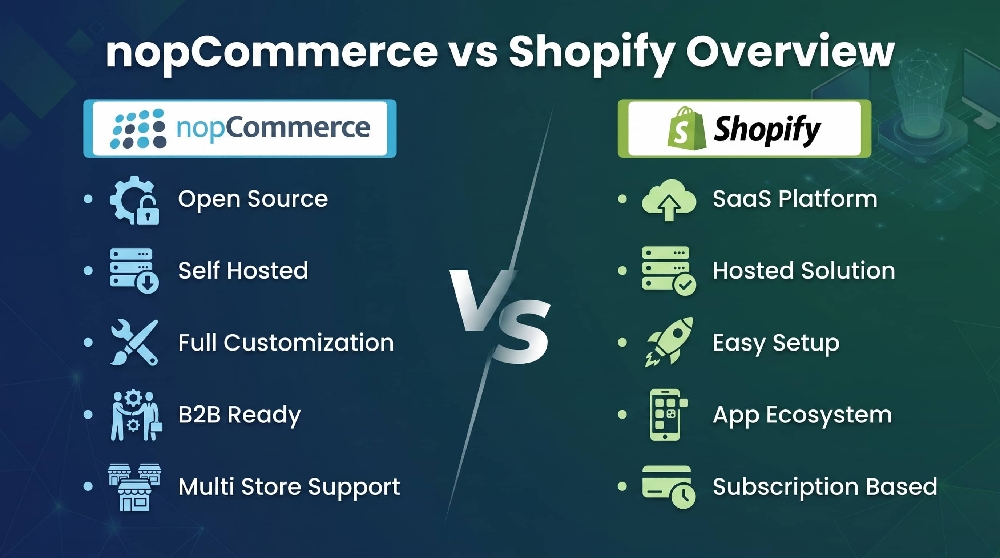
nopCommerce is an open-source eCommerce platform built on Microsoft's ASP.NET Core framework. It's been around since 2008, and unlike SaaS platforms, it isn't something you rent, you download the source code, host it wherever you choose, and own every line of it.
That ownership model shapes who actually uses it. nopCommerce tends to power mid-market and enterprise catalogs: industrial suppliers running tens of thousands of SKUs, B2B wholesalers managing tiered pricing across hundreds of customer accounts, and manufacturers who need a storefront that syncs directly with an ERP or PIM system. It's also a favorite among .NET development teams and agencies, since the codebase, the MVC architecture, and the plugin framework all speak a language their developers already know.
In the broader market, nopCommerce sits in the same conversation as Magento, a self-hosted platform built for businesses that need deep customization and are willing to invest in development to get it, rather than work within a fixed feature set.
What is Shopify?
Shopify is a fully hosted, subscription-based SaaS platform. You sign up, pick a plan, choose a theme, and you can have a functioning storefront live within a day with no server setup, no code, no developer required for a basic launch.
That accessibility explains why Shopify dominates the DTC and small-to-mid-size retail space. Solo founders, fashion brands, subscription box companies, and social-commerce sellers gravitate toward it because the barrier to entry is so low. The platform handles hosting, security patches, and PCI compliance behind the scenes, and its app marketplace lets non-technical owners add functionality reviews, upsells, and loyalty programs without touching a line of code.
Shopify's stack is proprietary, built around its own Liquid templating language with a REST and GraphQL Admin API for custom integrations. Market-wise, it's the default choice for fast-moving consumer brands, and through Shopify Plus, it has made real inroads into enterprise and B2B territory though, as we'll get into, that tier carries enterprise-level pricing too.
nopCommerce vs Shopify Comparison Table
Pricing Comparison
nopCommerce Costs
nopCommerce itself costs nothing to download or license. That's the headline, and it's true. But "free software" and "free to run" are two different things, and any consultant who tells you otherwise isn't being straight with you.
The actual costs break down into a few buckets. Hosting comes first since you're self-hosting, you pay for a server sized to your traffic and catalog, ranging from modest shared-cloud setups for a small store up to several hundred dollars a month for an enterprise deployment on Azure or AWS. Development is usually the larger line item: getting a store live with your branding, workflows, and integrations is a project, not a subscription, and the investment scales with how much customization you actually need. Maintenance is ongoing applying updates, monitoring performance, patching security and is typically handled through a retainer with a development partner rather than a recurring platform fee.
The upside is straightforward: every dollar spent on development becomes an asset you own, with no monthly toll layered on top of what you've already built.
Shopify Costs
Shopify's pricing is more predictable on the surface, which is part of its appeal. As of 2026, the core plans run from a $5/month Starter tier (essentially a checkout link for social selling, not a full store) up to $39/month for Basic, $105/month for Grow, and $399/month for Advanced, with roughly 25% off if you pay annually. Step up to Shopify Plus the tier most enterprise and serious B2B sellers end up needing and pricing starts around $2,300/month.
Then there are the costs that don't show up on the pricing page. Unless you process payments through Shopify Payments, you'll pay an additional transaction fee on every sale, on top of standard card processing rates. Premium themes can run into the hundreds of dollars as a one-time cost, and most stores end up running a handful of paid apps for reviews, upsells, inventory sync, or email marketing each with its own monthly fee that adds up quickly once you're running ten or fifteen of them.
None of this makes Shopify a poor value. For a business that needs to launch fast without deep customization, the all-in monthly cost is often lower than an equivalent nopCommerce build in year one. The economics shift over a three-to-five-year horizon, which is the long-term cost question every growing business eventually has to answer.
Long-term cost considerations: Shopify's costs scale with your subscription tier and app stack the more functionality you need, the more you pay, indefinitely. nopCommerce's costs are front-loaded into development, then taper into maintenance. If your operation is fairly standard physical products, common checkout flows, a handful of integrations Shopify's recurring cost stays manageable. If you're running complex B2B pricing, multiple storefronts, or deep ERP integration, those Shopify app fees and Plus-tier requirements can quietly outpace what a custom nopCommerce build would have cost over the same stretch of time.
Customization & Development Flexibility
nopCommerce Advantages
This is where nopCommerce earns its reputation among technical teams. Full access to the source code means there's no real ceiling on what you can build. Need a checkout flow that branches based on customer type, region, and order volume simultaneously? Build it. Need a product configurator pulling live pricing from a manufacturing system? That's a plugin, not a workaround.
The plugin architecture is genuinely well-designed; most customizations don't require touching core code, which keeps upgrades manageable. Combined with open API access for connecting to ERPs, CRMs, and PIMs, nopCommerce gives a development team the kind of latitude you'd expect from a custom-built application, minus the years it would otherwise take to build the eCommerce fundamentals from scratch.
Shopify Advantages
Shopify's strength runs in the opposite direction: speed and accessibility. A merchant with zero technical background can pick a theme, add products, configure shipping, and be selling within a day. For straightforward catalogs and standard business models, that's a genuine advantage, and not one nopCommerce tries to compete with.
The trade-off shows up the moment requirements stop being standard. Shopify's Liquid theming and app-based architecture are flexible within bounds, but those bounds are real; you're customizing within Shopify's framework, not rebuilding it. Complex custom logic often means stacking multiple apps together, which introduces its own maintenance burden and points of failure. nopCommerce's learning curve is steeper, and you'll need .NET development expertise to take full advantage of it, but there's no functional ceiling once you're past initial setup.
SEO Capabilities Comparison
Both platforms can rank well; plenty of Shopify stores sit on page one, and so do plenty of nopCommerce sites. The difference shows up once your SEO strategy gets specific.
nopCommerce gives full control over URL structure, which matters more than it sounds. Category and product URLs can be structured however your strategy calls for, without fighting platform defaults. Metadata, canonical tags, and structured data can be implemented exactly as your SEO team specifies, since you control the templates directly. Site speed is also in your hands caching, CDN configuration, and server resources can be tuned to whatever performance benchmark you're targeting.
Shopify's built-in SEO tools are genuinely solid for standard use cases: automatic sitemaps, customizable meta titles and descriptions, and decent default markup. Where it gets restrictive is URL architecture product and collection URLs are locked into /products/ and /collections/ patterns that can't be fully removed, which can matter for businesses with established SEO equity built around a different structure. Deeper schema customization or non-standard structured data often requires app workarounds rather than direct implementation.
A practical scenario: a B2B distributor migrating from a legacy system wants product URLs that mirror their printed catalog's SKU structure, for consistency across offline and online channels. On nopCommerce, that's a routing configuration. On Shopify, it's either accepting the platform's URL pattern or building custom redirect logic to compensate.
Performance & Scalability
Scalability means different things depending on what's actually growing traffic, catalog size, store count, or geographic footprint.
For traffic spikes, Shopify has the edge out of the box. It runs on infrastructure designed to absorb flash-sale-level surges without intervention, which matters enormously for a DTC brand running a major product drop. nopCommerce can handle the same load, but the responsibility for sizing and scaling infrastructure sits with you, which means more control but also more upfront planning.
For catalog size, the dynamic flips. Businesses running tens of thousands of SKUs, complex variant structures, or B2B pricing matrices tend to find nopCommerce's architecture more accommodating, since the database and application layer can be tuned specifically for that load rather than shared across a SaaS environment.
Multi-store management is one of nopCommerce's clearer wins: a single admin panel can run multiple storefronts in different domains, currencies, or languages without paying for separate platform licenses. Shopify can do this too, but it generally means separate subscriptions per store, or stepping up to Plus for its expansion-store allowance.
International expansion follows a similar pattern. Both platforms support multi-currency and multi-language selling, but nopCommerce's native multi-store and localization framework tends to suit businesses running genuinely distinct regional storefronts, while Shopify Markets is well-suited to a single store selling across borders with localized pricing and checkout.
B2B eCommerce Features
B2B is where the platform choice tends to get the most consequential, because B2B workflows rarely fit a one-size-fits-all template.
nopCommerce includes meaningful B2B functionality out of the box: customer role-based permissions, tiered and customer-specific pricing, registration-gated catalogs, and account approval workflows. More advanced needs quote-to-order processes, credit-limit-based purchasing, layered approval chains for corporate buyers typically require custom development, but the open architecture makes that development straightforward rather than a fight against the platform.
Shopify has invested seriously in B2B over the past few years, with company accounts, custom price lists, and net payment terms. The catch is that this functionality lives primarily on Shopify Plus, the highest-priced tier. For a wholesaler comparing costs, that's an important detail: the B2B features that make Shopify viable for serious wholesale operations aren't available on the lower-cost plans.
Multi-vendor support relevant if you're running a marketplace model is a native nopCommerce capability through its vendor management system. Shopify's multi-vendor functionality, by contrast, generally relies on third-party apps rather than built-in tooling.
Security & Compliance
Security responsibility splits along the same line as everything else here: who's hosting, and who's accountable.
With Shopify, PCI compliance and platform-level security are handled by Shopify itself. Updates roll out automatically, and there's no need to patch servers or manage infrastructure vulnerabilities directly. That's a genuine relief for businesses without in-house technical staff.
With nopCommerce, you or your hosting and development partner own that responsibility. The flip side is that you also own the data. Customer information, order history, and business intelligence live on infrastructure you control, rather than inside a third party's environment. For businesses in regulated industries, or those with strict data residency requirements (common across the UAE, Saudi Arabia, and parts of the EU), that level of control is often a requirement rather than a preference. PCI compliance is fully achievable on nopCommerce, but it's something your hosting setup needs to be built around, not something that arrives free with the platform.
Integrations & Extensions
Shopify's app marketplace has enormous payment gateways, shipping carriers, marketing automation, and accounting tools almost all have a pre-built, install-and-go app. For standard integrations, that's hard to beat on speed.
nopCommerce's plugin marketplace is smaller, but the open API compensates for it. Connecting to an ERP system, a custom CRM, or a proprietary inventory tool is generally a development task rather than a search for an app that may or may not exist which matters for businesses running non-standard backend systems, a description that fits most established B2B and manufacturing operations. Payment gateways and shipping providers are well-covered through both official plugins and direct API integration.
Which Platform Is Better for Different Business Types?
Startups
Most startups should default to Shopify, full stop. The priority at this stage is validating demand and getting to market fast, not investing in custom infrastructure. Save the platform conversation for when you've got traction.
Small Businesses
For small businesses with standard catalogs and straightforward operations, Shopify's low barrier to entry and predictable monthly cost usually wins. nopCommerce becomes worth considering once "standard" stops being an accurate description of your business.
Growing Brands
This is the inflection point. Brands hitting six and seven figures in revenue often start feeling Shopify's app costs and customization limits at the same time. It's worth running the numbers on a custom nopCommerce build at this stage, even if the answer turns out to be "not yet."
B2B Companies
B2B businesses with tiered pricing, account-based catalogs, or corporate purchasing workflows tend to find nopCommerce's native capabilities a stronger starting point, especially when Shopify Plus pricing is the only route to comparable B2B tooling.
Enterprise Businesses
Enterprises with complex, often non-standard workflows multiple business units, ERP-driven operations, deep customization needs generally get more long-term value from nopCommerce's ownership model, though Shopify Plus remains a credible option for enterprises whose needs look more like "very large DTC brand" than "complex B2B operation."
International Sellers
Sellers running genuinely distinct regional storefronts, with different catalogs, currencies, and compliance requirements per market, tend to benefit from nopCommerce's native multi-store framework. Sellers running a single store across multiple countries often do fine with Shopify Markets.
When Should You Choose nopCommerce?
Choose nopCommerce when:
You need full ownership of your platform, code, and data, rather than a rented subscription to someone else's infrastructure
Your business runs on workflows too specific for a templated SaaS platform to accommodate
You're integrating deeply with an ERP, PIM, or proprietary system, and need that integration built as a first-class part of the architecture, not an app workaround
B2B functionality tiered pricing, account approval, corporate purchasing is core to how you sell, not an afterthought
You're scaling toward enterprise-level catalog size or multi-store complexity and want infrastructure that grows with you, rather than a subscription tier that gates your growth
When Should You Choose Shopify?
Choose Shopify when:
You need to launch quickly and validate a business model before committing to deeper infrastructure
You don't have in-house technical resources and don't want to manage hosting, security patches, or server maintenance
Your catalog and operations are relatively standard physical products, common checkout flows, well-covered integrations
You're a DTC brand whose growth path is primarily about marketing and traffic rather than complex backend logic
Why Businesses Choose Shivaay Soft for nopCommerce Development
If the case for nopCommerce resonates with where your business is headed, the platform is only half the equation the team building on it is the other half.
At Shivaay Soft, nopCommerce development is what we do, not a side offering alongside a dozen other platforms. Our team works at the source-code level, so we're not limited to whatever a plugin marketplace happens to offer. We build custom plugins when your workflow needs something that doesn't exist yet, design and develop themes that match your brand rather than a modified template, and handle API integrations that connect your storefront to ERP, CRM, PIM, and accounting systems without duct tape holding it together.
Performance optimization is a recurring engagement for many of our clients a self-hosted platform is only as fast as the infrastructure and code behind it, and that's an area where experienced tuning makes a measurable difference. We also handle migrations, including Shopify-to-nopCommerce moves for businesses that have outgrown their SaaS setup and need their catalog, customer data, and order history moved over cleanly.
And because nopCommerce is a long-term platform decision, we stick around past launch ongoing support, version upgrades, and continued development as your business changes, rather than a one-time build followed by a goodbye.
Conclusion
There's no version of this comparison that ends with a universal winner, and any article claiming otherwise is selling something. The honest answer to nopCommerce vs Shopify depends entirely on where your business is and where it's trying to go.
If you're launching fast, working with a standard catalog, and don't have in-house technical resources, Shopify will get you to market faster and with less friction. If you're running a B2B operation, managing complex pricing and corporate purchasing workflows, integrating deeply with backend systems, or planning to scale toward genuine enterprise complexity, nopCommerce's ownership model and unlimited customization tend to pay off, often within the first two to three years, once Shopify's recurring app and platform costs are weighed against a nopCommerce build you actually own outright.
The strategic move isn't picking the platform with the better reputation. It's mapping your real business requirements, pricing complexity, integration needs, growth trajectory, technical resources against what each platform genuinely supports, and choosing accordingly. If that mapping points toward nopCommerce, or if you're simply not sure yet, that's exactly the conversation worth having before you commit