

Picking an eCommerce platform is one of the most consequential technology decisions a business will make - and one of the most commonly underestimated. Many businesses rush into a platform based on price, a vendor's pitch, or a competitor's choice, only to spend years fighting limitations they never anticipated: performance bottlenecks during peak sales, inflexible checkout flows, licensing costs that balloon with growth, or a plugin ecosystem that's three versions behind.
The eCommerce market is moving faster than ever. Buyers expect personalized experiences. B2B purchasing has moved online. Mobile shopping now dominates traffic. And the technical requirements to keep pace - headless commerce, API-first architecture, real-time inventory sync, multi-currency support - have raised the bar considerably.
Against this backdrop, the platforms that businesses choose nopCommerce over legacy alternatives for are the ones built on solid engineering foundations. nopCommerce, now in its most mature iteration and running on ASP.NET Core, has quietly become one of the most capable open-source eCommerce platforms available for businesses that take their online operations seriously.
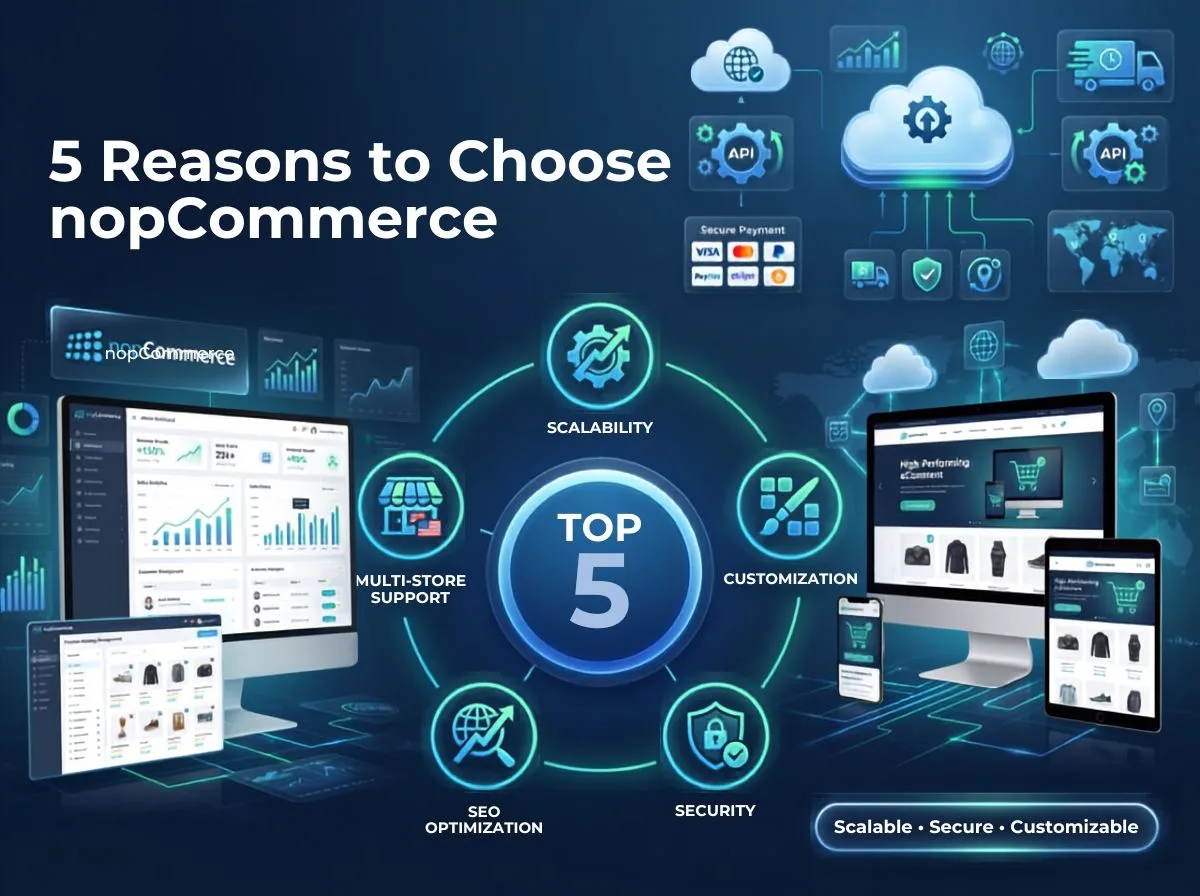
This article breaks down five concrete reasons why nopCommerce deserves a spot at the top of your shortlist in 2026 - whether you're a startup preparing for your first online store, a B2B manufacturer moving complex workflows online, or an enterprise retailer managing thousands of SKUs across multiple markets.
Why Platform Selection Matters More Than Ever
A few years ago, the main consideration for most businesses was simply "will it sell products online?" That question is no longer sufficient.
Customer expectations have shifted dramatically. Shoppers compare your site against Amazon, not against your local competitor. They expect sub-two-second page loads, mobile-native experiences, saved carts, loyalty programs, and personalized recommendations at minimum.
At the same time, businesses are expanding their reach. Selling across multiple channels your website, a marketplace, a physical POS, and a wholesale portal has become standard rather than exceptional. The platform underneath needs to support this without requiring a separate system for each channel.
Scalability is another pressure point. A platform that handles 500 orders a month gracefully may collapse under 5,000. And migrating platforms mid-growth is expensive, risky, and disruptive. Getting the architecture right early or at least choosing a platform with the headroom to grow protects long-term ROI.
Security is non-negotiable. GDPR, PCI DSS, and regional data protection regulations have real teeth. A data breach or payment compromise doesn't just cost money it destroys the customer trust that eCommerce businesses depend on.
nopCommerce addresses all of these concerns. Here's how.
Reason 1: Built for Scalability
Most eCommerce platforms perform adequately when stores are small. The real stress test comes when a business starts growing - more products, more traffic, more concurrent users, more order complexity. That's where architectural decisions made years ago either pay off or become painful.
nopCommerce is built on ASP.NET Core, Microsoft's high-performance, cross-platform framework. It supports asynchronous processing natively, which means the platform handles concurrent user requests efficiently without degrading under load. For context, ASP.NET Core consistently ranks among the fastest web frameworks in independent benchmarks.
For product catalogs, nopCommerce handles tens of thousands of SKUs without structural changes. The platform's attribute management, product variants, and inventory tracking systems are designed for depth, not just breadth. A furniture retailer managing products with dozens of configuration options: wood finish, dimensions, fabric, leg style can model that complexity cleanly without hacks or workarounds.
Cloud deployment is straightforward. nopCommerce runs on Microsoft Azure, AWS, and Google Cloud Platform, and supports containerized deployments via Docker. This means businesses can scale horizontally during peak periods Black Friday, product launches, seasonal demand without over-provisioning infrastructure year-round.
Consider a real-world scenario: a mid-sized electronics distributor managing 15,000 products across 3 regional stores. With nopCommerce's multi-store architecture and cloud deployment, they can serve all three markets from a single codebase while maintaining separate catalogs, pricing, and branding for each. That's enterprise-grade capability without enterprise-grade licensing costs.
Reason 2: Unlimited Customization with Open-Source Flexibility
Proprietary SaaS platforms have a fundamental tension built into their model: the vendor's interests and the customer's interests don't always align. Features get road mapped on the vendor's timeline. Integrations require approved partners. Custom logic lives in "apps" that introduce dependencies and recurring costs. At some point, every growing business hits a ceiling.
nopCommerce eliminates that ceiling. As a fully open-source platform, the entire source code is available without restriction. Your development team or a partner like Shivaay Soft can modify any part of the system, from the data layer to the checkout flow to the admin interface.
This matters practically in several ways:
Custom plugin development allows businesses to build functionality that doesn't exist anywhere else. A B2B distributor might need a custom quoting engine that integrates with their ERP system's pricing logic. A subscription box business might need a build-your-own-box feature with specific bundling rules. These requirements can be built cleanly as nopCommerce plugins without touching core files, which makes future upgrades much simpler.
Theme customization goes beyond changing colors and fonts. The entire frontend presentation layer is accessible. Businesses can implement fully custom UI designs, integrate headless frontend frameworks, or build Progressive Web App experiences on top of nopCommerce's robust backend.
API integrations are well-supported. nopCommerce exposes a comprehensive REST API, and the plugin architecture makes it straightforward to build bidirectional integrations with ERPs (SAP, Microsoft Dynamics, NetSuite), CRMs (Salesforce, HubSpot), shipping carriers (FedEx, DHL, UPS), accounting platforms, and marketing automation tools.
The nopCommerce marketplace also provides hundreds of pre-built plugins covering common requirements, reducing development time for standard functionality while keeping custom development available for anything unique to your business.
Reason 3: Powerful Features for B2B & B2C Commerce
One area where nopCommerce genuinely outpaces many competitors is its native support for complex commerce scenarios, particularly B2B. Many platforms require significant workarounds or expensive third-party apps to support basic B2B requirements. nopCommerce includes them out of the box.
Multi-store management lets businesses run multiple storefronts from a single backend installation. Each store can have its own domain, branding, product catalog, pricing, and payment methods while sharing inventory, customer data, and order management infrastructure. This is particularly valuable for businesses with multiple brands, regional markets, or B2B and B2C channels that need to remain operationally separate.
Customer roles and segmentation give businesses precise control over what different customer groups see and pay. A wholesale customer might see different pricing, have access to a bulk order form, and skip certain checkout steps that retail customers go through. A VIP segment might see exclusive products or early access to sales. These workflows are configurable without custom development.
Tier pricing is native. Businesses can configure pricing rules based on quantity, customer group, product combination, or promotional conditions all within the admin interface. For manufacturers and distributors with complex pricing agreements, this is a significant operational advantage.
Multi-vendor support allows marketplace-style operations where multiple sellers manage their own product listings, fulfill their own orders, and receive their own payouts all under your platform's umbrella.
Payment flexibility is broad. nopCommerce supports PayPal, Stripe, Authorize .NET, Braintree, and dozens of regional payment gateways, along with buy-now-pay-later options, wire transfer for B2B, and custom payment workflows. Shipping supports real-time rate calculation from major carriers, custom shipping rules, and zone-based pricing.
Reason 4: SEO-Friendly & Performance Optimized
For most eCommerce businesses, organic search remains a primary acquisition channel. A platform that creates technical SEO problems, poor URL structures, missing canonical tags, slow page loads, and non-indexable content quietly drains marketing ROI over time.
nopCommerce is built with SEO as a first-class concern, not an afterthought.
Clean, configurable URLs are standard. Product pages, categories, and manufacturer pages all support custom slugs. There are no session IDs, no meaningless query strings, no hash-based routing that search engines struggle to crawl.
Meta management is granular. Title tags, meta descriptions, and Open Graph data can be configured independently for every product, category, and CMS page either manually or programmatically via bulk tools. This matters for stores with thousands of products where unique metadata at scale requires workflow support.
Structured data is supported for product markup, breadcrumbs, and reviews giving Google the signals needed to generate rich snippets in search results. Rich snippets (star ratings, price ranges, availability) measurably improve click-through rates.
Core Web Vitals performance has been a Google ranking factor since 2021. nopCommerce supports response compression, static file caching, database query optimization, and CDN integration, the technical building blocks for hitting the performance thresholds Google measures. With proper hosting and configuration, nopCommerce stores regularly achieve strong Core Web Vitals scores.
Mobile responsiveness is built into the default themes and the template system. With mobile traffic accounting for the majority of eCommerce visits in most markets, this is a baseline requirement, not a differentiator but it's handled correctly here.
Reason 5: Strong Security & Long-Term Growth
Security in eCommerce isn't a feature you add, it's a foundation you build on. A platform's security posture affects PCI DSS compliance, GDPR adherence, customer trust, and ultimately, the business's ability to process payments at all.
nopCommerce's security foundation starts with ASP.NET Core, which includes built-in protections against common web vulnerabilities: SQL injection, cross-site scripting (XSS), cross-site request forgery (CSRF), and open redirect attacks. These protections are structural; they're part of the framework, not bolt-on modules that can be forgotten or misconfigured.
User permission management is granular. Admin roles can be defined with precise access controls a warehouse manager might have access to order fulfillment but not pricing configuration. This limits internal risk and supports audit requirements for enterprise and regulated industries.
Secure checkout supports HTTPS enforcement, tokenized payment processing (meaning sensitive card data never touches your servers), and integration with 3D Secure authentication for card-not-present fraud reduction.
Regular updates from the nopCommerce team address security vulnerabilities promptly. Because the platform is open source, the security community also scrutinizes the codebase, which tends to produce faster identification and remediation of issues compared to closed-source platforms.
For long-term growth, the combination of an active development team, a large global community, and an open architecture means nopCommerce adapts as the market evolves. Headless commerce architectures, Progressive Web App frontends, AI-driven personalization - these can all be layered onto a nopCommerce backend without platform replacement.
Who Should Choose nopCommerce?
nopCommerce isn't the right fit for every situation - no platform is. But for certain business profiles, it's a particularly strong match.
Startups with serious ambitions benefit from a platform that won't require migration once traction arrives. Building on nopCommerce from day one means the architecture can support the business at scale without rebuilding.
Small businesses with complex product configurations or specific operational workflows, custom pricing, unique fulfillment logic, specialized integrations find that nopCommerce's flexibility pays off quickly compared to constrained SaaS alternatives.
B2B companies moving procurement online, or manufacturers building dealer portals, get native support for the features that B2B commerce requires: customer-specific pricing, purchase order workflows, multi-contact accounts, and approval processes.
Enterprise retailers managing large catalogs, high traffic, multiple brands, or international markets benefit from nopCommerce's performance architecture and multi-store capabilities.
Multi-store businesses franchises, regional operators, businesses with distinct B2B and B2C channels can consolidate operations under a single platform instance while maintaining appropriate separation between each store's experience and data.
How Shivaay Soft Helps Businesses Succeed with nopCommerce
Building a successful nopCommerce store requires more than installing the platform. The architecture decisions, customization choices, and integration approaches made during development have compounding effects on the store's performance, maintainability, and total cost of ownership over time.
Shivaay Soft is a specialized nopCommerce development company with certified developers who work exclusively within the platform's ecosystem. The team brings practical experience across the full lifecycle of nopCommerce projects from greenfield builds to complex migrations from Magento, WooCommerce, and Shopify.
Custom plugin development: When your business requirements don't fit a standard configuration, Shivaay Soft builds custom plugins that extend nopCommerce's functionality cleanly - maintaining upgrade compatibility and avoiding the technical debt that comes from hacking core files.
Theme development: From pixel-perfect implementations of existing designs to ground-up custom theme builds, the team delivers performant, mobile-optimized storefronts that reflect your brand accurately.
Store migration: Moving from another platform to nopCommerce involves more than copying data. Product attributes, customer history, order records, SEO redirects, and integration configurations all need careful handling. Shivaay Soft has a structured migration methodology that protects data integrity and minimizes business disruption.
API integrations: ERP connections, CRM sync, shipping carrier APIs, payment gateway integrations, marketing automation webhooks the team builds and maintains the integrations that keep your commerce operations connected.
Performance optimization: Site speed directly affects conversion rates and search rankings. Shivaay Soft conducts performance audits and implements targeted optimizations caching strategies, database query tuning, image optimization pipelines, CDN configuration with measurable results.
Ongoing maintenance and support: Post-launch, the team provides platform updates, security patches, performance monitoring, and feature development so your store keeps pace with your business.
Conclusion
The five reasons explored in this article: scalability, open-source customization, B2B and B2C feature depth, SEO optimization, and security collectively explain why businesses choose nopCommerce when they're making a platform decision with a long time horizon in mind.
It's not the easiest platform to spin up for a simple five-product store. But for businesses that have real complexity to manage, real growth to plan for, and real operational requirements to meet, nopCommerce consistently delivers. The combination of ASP.NET Core's performance foundation, full source code access, and a mature feature set covers a wide range of commerce use cases without requiring a second platform, an enterprise license upgrade, or a risky migration in three years.
If your business is evaluating eCommerce platforms in 2026, nopCommerce deserves a serious look and partnering with experienced nopCommerce developers from day one makes that investment significantly more likely to pay off.