

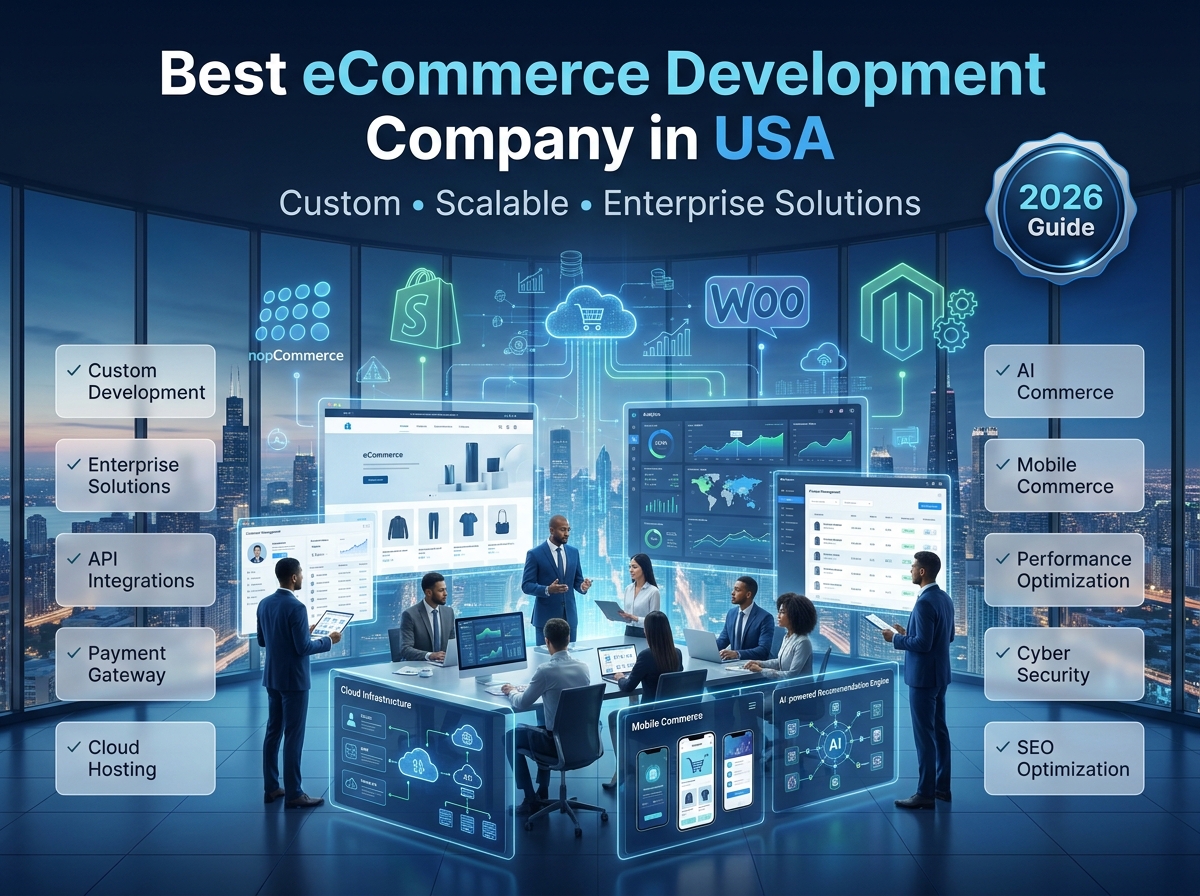
Choosing a development partner is not a line item. It is a decision that shapes how fast your store loads, how well it converts, how easily it scales, and how much money you spend fixing avoidable problems three years from now. Most business owners don't realize how much this one decision compounds until they're stuck with a platform that can't handle a Black Friday traffic spike or a codebase nobody on the current team wants to touch.
U.S. eCommerce has moved well past the "nice to have a website" stage. Online retail sales in the United States have been growing steadily year over year, and a growing share of that spend now happens on mobile, through marketplaces, and across B2B portals that didn't exist a decade ago. Customers expect a fast, secure, personalized experience regardless of whether they're buying a $40 gadget or placing a $40,000 wholesale order.
That expectation puts real pressure on the technology behind the storefront. A store built on outdated architecture, patched-together plugins, or a platform that was never meant to scale will eventually become the bottleneck for the entire business. This is why scalable technology and thoughtful digital transformation planning matter as much as marketing budgets and product quality.
This guide is written for business owners, CTOs, IT directors, and digital teams who are trying to answer one practical question: how do you actually identify the best eCommerce development company in the USA for your specific situation? We'll walk through what separates a capable partner from an average one, the services that matter most in 2026, the trends reshaping the industry, and the questions you should ask before signing anything.
Why Businesses Need a Professional eCommerce Development Company
A do-it-yourself store builder or a freelancer working nights and weekends can get you online. It usually cannot get you competitive. There's a meaningful difference between having a store and having a store that performs.
Better customer experience. Professional development means the site is built around how real customers browse and buy, not just how a template happens to be laid out. Navigation, search, filtering, and checkout are designed as a connected journey rather than separate features bolted together.
Higher conversion rates. Small technical decisions, page load time, checkout friction, mobile responsiveness, have an outsized effect on whether a visitor completes a purchase. A professionally engineered store treats conversion rate as an ongoing engineering problem, not just a marketing one.
Faster websites. Speed is not cosmetic. Every additional second of load time increases the chance a visitor leaves before your product even loads. Experienced developers know how to optimize images, database queries, caching layers, and server configuration so the site stays fast even as the catalog grows.
Secure online shopping. Payment data, customer records, and order history are all attack targets. A professional partner builds security into the architecture from day one, rather than patching it in after an incident.
Business automation. Manual order processing, inventory updates, and customer service tasks don't scale. Good development connects your store to ERP, CRM, and fulfillment systems so information moves automatically instead of through spreadsheets and email.
Long-term scalability. The store that works fine at 500 orders a month can collapse at 5,000. A professional partner designs for the business you're becoming, not just the business you are today.
What Makes an eCommerce Development Company the Best?
Best is subjective until you break it into measurable qualities. Here's what actually separates strong development partners from average ones.
Technical expertise. Not just familiarity with a platform, but depth: understanding the platform's limitations, its extension architecture, its performance characteristics under load, and how to customize it without breaking future upgrades.
Industry experience. A team that has built stores for manufacturers, wholesalers, and B2B brands understands pricing tiers, quote workflows, and account hierarchies that a purely B2C-focused agency may never have encountered.
Portfolio. A track record of live, functioning stores, ideally ones you can visit and test, tells you more than any pitch deck. Look for variety across industries and complexity levels.
Certified developers. Certifications from platform vendors (nopCommerce, Microsoft, cloud providers) indicate a baseline of verified technical competency, not just self-reported skill.
Cloud deployment. Modern stores need to run reliably on cloud infrastructure that can scale up during peak demand and scale back down afterward, without manual intervention every time traffic spikes.
Security. PCI compliance awareness, secure coding practices, and regular vulnerability testing should be standard practice, not an upsell.
API integrations. Your store rarely operates alone. It needs to talk to payment processors, shipping carriers, ERPs, CRMs, and marketplaces. A strong partner treats integration work as core competency.
Mobile-first development. With a majority of shopping traffic now coming from phones, mobile experience can't be an afterthought bolted onto a desktop-first build.
Performance optimization. Ongoing attention to page speed, database efficiency, and caching, not a one-time audit before launch.
Ongoing support. Development doesn't end at launch. Bugs surface, platforms release updates, and business needs change. A partner who disappears after go-live leaves you exposed.
Essential Services Every Top eCommerce Development Company Should Offer
A capable partner should be able to support the full lifecycle of your store, not just the initial build.
Custom eCommerce Development
Off-the-shelf templates work for simple stores. Complex catalogs, tiered pricing, multi-warehouse inventory, or unique checkout logic usually require custom development built around your specific workflows rather than forcing your business to adapt to a template's limitations.
nopCommerce Development
nopCommerce is an open-source, ASP.NET-based platform well suited to businesses that need deep customization without vendor lock-in. It's particularly strong for B2B scenarios, multi-store setups, and companies that want full control over their codebase and hosting environment.
Shopify Development
Shopify suits businesses that want speed to market and a managed hosting environment, with a large app ecosystem for extending functionality without heavy custom code.
WooCommerce Development
Built on WordPress, WooCommerce works well for content-driven brands that want to combine blogging, SEO content, and commerce within one system.
Magento Development
Magento (Adobe Commerce) remains a common choice for larger catalogs and complex merchandising needs, though it typically requires more hosting and maintenance investment than lighter platforms.
Custom Theme Development
A theme should reflect your brand and your customers' shopping behavior, not just a generic layout reused across hundreds of other stores. Custom themes also tend to load faster because they don't carry unused code from a general-purpose template.
Plugin Development
When existing extensions don't cover a specific business requirement, custom plugin development fills the gap, whether that's a unique pricing rule, a specialized search filter, or an internal workflow tool.
API Integration
Connecting your store to third-party services, payment gateways, shipping providers, marketplaces, is often where the real complexity of a project lives. Clean API integration keeps data accurate across every system.
ERP Integration
Syncing inventory, orders, and financials between your store and your ERP eliminates duplicate data entry and reduces costly fulfillment errors.
CRM Integration
Connecting customer data between your store and CRM supports better segmentation, follow-up, and retention efforts.
Payment Gateway Integration
Secure, reliable checkout depends on properly configured payment gateways that support the currencies, methods, and fraud protections your customers expect.
Shipping Integration
Real-time rate calculation, label generation, and tracking updates all depend on solid shipping carrier integrations.
Marketplace Integration
Many brands sell across their own store plus marketplaces like Amazon or Walmart. Integration work keeps inventory and pricing synchronized across every channel.
Performance Optimization
Ongoing tuning of caching, database queries, image delivery, and server configuration keeps the store fast as traffic and catalog size grow.
Cloud Migration
Moving from legacy or on-premise hosting to cloud infrastructure improves reliability, scalability, and often reduces long-term hosting costs.
Store Maintenance
Regular updates, bug fixes, and monitoring prevent small issues from becoming major outages.
Security Audits
Periodic reviews identify vulnerabilities before attackers do, an increasingly important practice as compliance requirements tighten.
Latest eCommerce Development Trends in 2026
Technology in this space moves quickly. Here's what's shaping development decisions right now.
AI-powered shopping. AI-driven product recommendations, search, and customer service chat are moving from novelty to expectation, helping shoppers find what they want faster.
Personalization. Stores increasingly tailor content, pricing, and product recommendations based on browsing history and account data, particularly in B2B contexts with negotiated pricing.
Headless Commerce. Separating the front-end presentation layer from the back-end commerce engine gives businesses more flexibility to build custom experiences across web, mobile, and other channels.
Composable Commerce. An extension of headless thinking, composable commerce lets businesses assemble best-of-breed tools (search, payments, content) rather than relying on one monolithic platform for everything.
B2B Commerce. Wholesale and manufacturing businesses are investing in self-service portals with tiered pricing, quick reorder tools, and account-based permissions that mirror how their sales teams already operate.
Voice Search. As voice assistants become more common in shopping research, structured product data and clear content help stores stay discoverable.
Progressive Web Apps. PWAs offer app-like speed and offline capability without requiring customers to install a native app, a practical middle ground for many mid-market brands.
AR Shopping. Augmented reality try-on and product visualization tools are becoming more accessible, particularly for furniture, apparel, and home goods categories.
Cloud Infrastructure. Elastic cloud hosting continues to replace fixed on-premise servers, letting stores handle seasonal traffic spikes without overpaying for idle capacity the rest of the year.
Omnichannel Retail. Customers expect consistent pricing, inventory visibility, and account data whether they're shopping online, in-store, or through a marketplace.
How to Choose the Right eCommerce Development Company
Portfolio. Ask to see live examples relevant to your industry and complexity level, not just polished screenshots.
Experience. Years in business matter less than relevant project experience. A five-year-old agency that has built twenty B2B stores is often a better fit than a fifteen-year-old agency that mostly does simple B2C sites.
Communication. Pay attention to how clearly they explain technical tradeoffs during the sales process. That's usually how they'll communicate once you're a client.
Technology stack. Make sure their platform recommendation is based on your actual requirements, not just what they happen to specialize in.
Development process. Ask how they manage requirements, testing, and change requests. A documented process reduces surprises later.
Project management. Clear timelines, milestones, and accountability structures matter more once a project is underway than they seem to during the pitch.
Support. Confirm what post-launch support looks like, response times, scope of coverage, and cost, before you sign anything.
Pricing. Understand what's included and what counts as a change order. The cheapest quote is rarely the cheapest total cost.
Security. Ask directly about their approach to secure coding, PCI compliance, and vulnerability testing.
Scalability. Ask how the architecture they're proposing would handle 3x or 10x your current order volume.
Common Mistakes Businesses Make
Choosing the cheapest provider. Low bids often mean corners cut on testing, security, or documentation, costs that resurface later as bugs, breaches, or expensive rebuilds.
Ignoring maintenance. A store is never "done." Skipping ongoing maintenance budgets leads to security gaps and slow performance degradation over time.
No scalability planning. Building only for current traffic and order volume creates a painful, expensive migration later when the business grows past what the platform can handle.
Weak SEO. Sites built without attention to page speed, structured data, and clean URL structures often struggle to rank, regardless of how good the design looks.
Poor integrations. Manual workarounds between systems that should talk to each other automatically waste staff time and introduce data entry errors.
Limited security. Treating security as a launch-day checkbox instead of an ongoing practice leaves stores vulnerable as new threats emerge.
No performance testing. Skipping load testing means the first real stress test happens during your busiest sales period, when failure is most costly.
Questions to Ask Before Hiring an eCommerce Development Company
Can you show live stores you've built that are similar in complexity to ours?
What platform would you recommend for our specific business model, and why?
How do you handle post-launch bugs and ongoing support?
What does your typical project timeline look like, and what causes delays?
How do you approach security and PCI compliance?
What happens if we need to scale beyond our current traffic volume?
How do you manage change requests once development has started?
What third-party systems have you integrated with before (ERP, CRM, shipping)?
Who on your team will actually be working on our project?
How do you handle site performance testing before launch?
What is your process for handling platform updates and security patches?
Can we own our source code and hosting environment?
What is included in your maintenance plan, and what costs extra?
How do you approach mobile responsiveness and cross-device testing?
What is your communication cadence during an active project?
Why Shivaay Soft Is a Trusted eCommerce Development Partner
Shivaay Soft works primarily with businesses that need more than a template store, companies running B2B operations, managing complex catalogs, or integrating multiple back-office systems into one storefront.
As a nopCommerce Gold Solution Partner, Shivaay Soft's team has deep, verified experience with the platform's architecture, extension model, and performance characteristics. That matters because nopCommerce customization done well requires understanding how the platform handles upgrades, plugin conflicts, and database performance at scale, not just how to install it.
The team includes certified developers working across ASP.NET, custom theme development, and plugin development, which means store customizations are built to fit the business rather than forcing the business to adapt to generic functionality.
For companies with more complex requirements, Shivaay Soft supports enterprise solutions covering multi-store setups, B2B pricing structures, and account-based permissions common in wholesale and manufacturing businesses.
Integration work spans third-party integrations, payment gateway integrations, and shipping integrations, connecting the storefront to the systems a business already relies on rather than creating a separate silo of data.
For businesses moving off legacy infrastructure, Shivaay Soft provides cloud deployment and migration services designed to minimize downtime and data loss during the transition.
Beyond launch, the team focuses on performance optimization and long-term maintenance, recognizing that a store's technical health needs ongoing attention rather than a one-time setup.
With global client experience across different markets and industries, the team brings perspective on what works across different business models, not just a single template applied repeatedly.
Success Story Example
The following is an illustrative example based on common patterns seen across mid-market eCommerce modernization projects. It is not a specific client case study.
Consider a mid-sized wholesale distributor running a legacy platform that hadn't been meaningfully updated in several years. Page load times averaged over six seconds on product pages. The checkout process required customers to call in for bulk pricing quotes because the platform couldn't handle tiered pricing automatically. Mobile traffic, now the majority of visits, rendered poorly on smaller screens.
After a modernization project, moving to a more flexible platform architecture, implementing automated B2B pricing tiers, optimizing images and caching, and rebuilding the mobile experience, the business saw meaningful improvement across key metrics:
Average page load time dropped from roughly 6 seconds to under 2 seconds
Mobile conversion rate improved by an estimated 40%
Support calls related to pricing quotes dropped significantly as automated tiered pricing took over
Cart abandonment decreased as checkout friction was reduced
These figures are illustrative of the kind of impact a well-executed modernization project can have, actual results vary by business, catalog complexity, and starting point.
Future of eCommerce Development
Looking ahead, several forces are reshaping how stores get built and maintained.
AI will continue moving from a marketing add-on to a core part of search, recommendations, and customer service, changing how product data needs to be structured.
Automation will keep expanding into inventory management, pricing updates, and order processing, reducing manual work across back-office operations.
Cloud-native platforms will become the default rather than the exception, as businesses prioritize elasticity and reliability over managing physical servers.
Headless commerce will keep gaining ground among businesses that want more control over front-end experience without rebuilding their entire commerce backend.
Enterprise integrations will deepen as businesses expect real-time data flow between storefronts, ERPs, CRMs, and fulfillment systems as a baseline requirement, not a premium feature.
Predictive analytics will help businesses anticipate demand, optimize inventory, and personalize marketing before a customer even searches.
Personalized customer journeys will extend further into B2B commerce, where account-specific pricing, catalogs, and reorder tools are becoming standard rather than exceptional.
Conclusion
There is no universal best eCommerce development company, there's the company that best matches your business model, technical requirements, and growth trajectory. A wholesale manufacturer with complex pricing tiers has different needs than a direct-to-consumer apparel brand, and the right partner understands that distinction from the first conversation.
What matters most is evaluating potential partners on real signals: relevant portfolio work, clear communication, a defined development process, honest answers about security and scalability, and a support plan that extends past launch day. The businesses that get burned are usually the ones that skipped these questions in favor of the lowest quote or the flashiest pitch.
Take the time to ask the hard questions before you sign a contract. The technology decisions you make now will either accelerate your growth for years or quietly hold it back.